Reference 1
Convert to Chessintion Format
https://github.com/xxjcaxx/ChessAIThon/blob/master/training/convert_students.ipynb
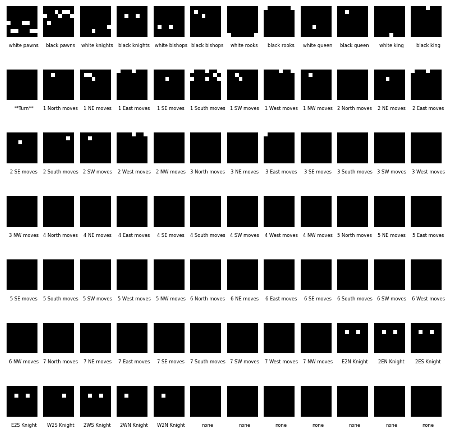
This Kaggle Notebook details the Extract, Transform, Load (ETL) process used to convert FEN files to our 77x8x8 format and to Parquet files optimized for AI training. It is an essential resource for replicating the data pipeline.
Reference 2
Mastering Chess and Shogi by Self-Play with a General Reinforcement Learning Algorithm (AlphaZero)
https://arxiv.org/abs/1712.01815
The seminal AlphaZero article that introduced tabula rasa Reinforcement Learning (RL) for chess. It provides the theoretical foundation for the neural network architecture, the multi-layer representation, and the use of MCTS for decision-making.
Reference 3
CNN PyTorch Chess Generic
https://www.kaggle.com/code/xxjcaxx/cnn-pytorch-chess-generic
Contains the training code for the ChessMarro Convolutional Neural Network (CNN) in PyTorch , using the 77x8x8 format . It is the code that implements the convolutional layers, normalization, and fully connected layers to predict the move.
Reference 4
Movement Coding: Example e2e4 to 820
https://xxjcaxx.github.io/ChessAIThon/docs/training_chessmarro/#conversion-trace-for-the-move-e2e4-to-index-820
This document explains the detailed trace of how a complex UCI move, such as 'e2e4' , is transformed into a single numerical index between 0 and 4095 (in this case, 820 ). This process is key for the CNN to perform prediction as a classification problem.
Reference 5
Monte Carlo Tree Search: Intelligent Game Strategy
https://xxjcaxx.github.io/ChessAIThon/docs/deploying_chessmarro#montecarlo-tree-search
Describes the operation of the MCTS algorithm and its role as a strategic planner, which compensates for the CNN's lack of long-term vision. It explains how the neural network acts as a guide (Neural MCTS ) to focus the search on the most promising moves.
Reference 6
Suggestions for required and suggested further reading to in depth the contents
Reference 7
The Leela Chess Zero (Lc0) documentation serves as a vital resource for understanding the practical application of deep learning in chess.
Referring to the official Leela Chess Zero documentation offers a practical bridge between theory and implementation. As an open-source project inspired by AlphaZero, it provides concrete insight into how neural networks are integrated into a functioning chess engine.
By studying Lc0, students move beyond the abstract concepts of the AlphaZero paper and see a "living" version of the technology. This documentation helps clarify the transition from a static data representation (like our 77x8x8 tensor) to a dynamic engine capable of playing at a Grandmaster level.
https://lczero.org/dev/