The ChessAIThon project (2025-1-ES01-KA220-VET-000354329) is co-funded by the European Union. The views and opinions expressed in this publication are those of the author(s) only and do not necessarily reflect those of the European Union or the Spanish Service for the Internationalisation of Education (SEPIE). Neither the European Union nor the National Agency SEPIE can be held responsible for them.

Methodology

This guide presents an operational methodology to support vocational education and training (VET) teachers in developing transversal skills and artificial intelligence (AI) foundations with their students through chess logic and problem-solving challenges. The proposal is based on a simple and powerful idea: chess acts as a “cognitive laboratory” in which structured reasoning, anticipation of consequences, decision-making under constraints and reflection on mistakes arise naturally and motivatingly, allowing for an integrated approach to critical thinking, planning, self-regulation and collaboration.

The pedagogical progression of the document was designed to be practical and compatible with professional teaching: it begins by consolidating programming fundamentals with concrete examples on the board (data representation, variables, flow control, functions, modularity), preparing students to think ‘like programmers’ before attempting to build more complex systems.

It then explains how the practice of chess can be used intentionally to promote cross-cutting skills — from metacognition and analytical thinking to resilience and socio-emotional skills — with classroom strategies that facilitate transfer to other curricular areas and professional contexts. 

With this foundation, the document moves on to the domain of ‘connection’ between programming and AI: data engineering in chess. It demonstrates how computers need to represent positions and games in appropriate formats (e.g., FEN/PGN and move protocols), how to choose dataset formats (CSV/JSON/Parquet), and how to organise data with professional versioning and collaboration practices (Git, sharing on platforms, and use in notebooks). This component is essential in professional teaching because it makes the complete cycle of a real project visible: collecting data, transforming, validating, storing and reusing it.

The next step introduces, in a manner geared towards technical teachers, the core concepts of modern AI applied to chess: Deep Learning with convolutional neural networks (CNN) to recognise spatial patterns on the board, structured numerical representations (such as the 77×8×8 tensor), move encoding and mechanisms to ensure valid moves (Boolean masks), culminating in integration with search algorithms such as Monte Carlo Tree Search (MCTS) to add strategic depth. The focus is not on “memorising theory”, but on enabling teachers to explain procedures and design decisions typical of systems inspired by approaches such as AlphaZero, adapted to educational contexts with limited resources.

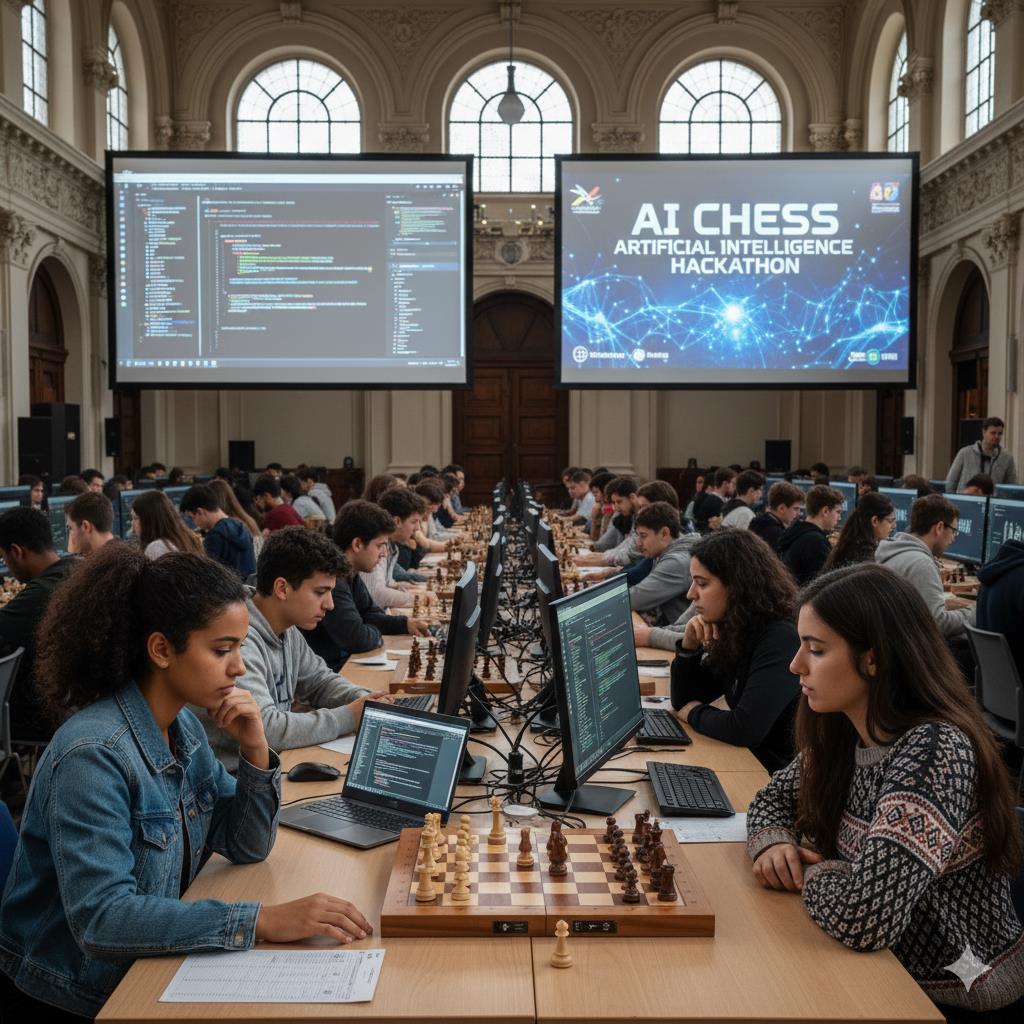
Finally, the methodology converges on a highly motivating and authentic component: the organisation of an AI chess competition (ChessAIthon) as a moment of consolidation. This final chapter provides a complete guide to designing and executing a fair and pedagogically relevant tournament, addressing not only formats and evaluation criteria, but also technical and ethical aspects (move validation, time management, failures, resource equity, transparency, and fair play), transforming the competition into a “real-world” learning experience.

Together, these chapters offer vocational education teachers a coherent path — from computational thinking and cross-cutting skills, to data engineering and AI fundamentals, to application in a practical event — enabling them to implement scalable, assessable activities aligned with the skills required in contemporary technical and professional contexts.


Using Chess logic and problem solving strategies to teach logic, functions and implementation of coding

The Chapter addresses the following contents

Paragraph 1 The Chessboard as a Data Structure: Addresses learning how to translate a real-world object (the chessboard) into a format that a computer can understand and manipulate. Contents are not for building a complete game engine yet; rather, learning to help students think like a programmer.

Paragraph 2 The Logic of Movement - Understanding Control Flow and Conditional Blocks: A computer program does not simply execute instructions from top to bottom; it must make decisions. In chess, you cannot move a piece wherever you want: strict rules exist. In computer science, these rules translate into Control Flow and Conditional Logic. The contents address how to learn to tell the computer: "If this happens, do this; otherwise, do that."

Paragraph 3 Moves and Rules – Modularity and Functions: addresses the issue on teaching how to break down a problem into subproblems, each solved by a specific function.

Parapgraph 4 Chess moves and validity checks as algorithms: addressing how to use loops to “scan” the chessboard and apply a linear search algorithm to detect any obstacles along a piece’s path, between the starting square and the destination square. In this way, preventing the rook from moving vertically or horizontally when there is a pawn in its way becomes possible

Paragraph 5 Towards AI – The Logic of Chess: addressing the difference between a computer that only knows how to move pieces, that is a "digital chessboard" and a computer that knows how to choose a move, that is an Artificial Intelligence. The last paragraph explores how computers "think" about the future, generating possibilities and predicting consequences. Finally, it builds a small "Solver" capable of finding a checkmate in 1 move. The paragraph represents the culmination of the journey: moving from checking whether a move is valid (defense) to actively seeking the best move (attack), entering the domain of Artificial Intelligence (AI).

Using Chess logic and problem solving strategies to develop Transversal skills

Chess, long celebrated for its strategic depth, functions as more than a game; it is a structured cognitive system that cultivates transversal skills applicable beyond the board. Engaging with chess develops critical thinking, analytical reasoning, and metacognitive awareness, as players plan, monitor, and evaluate their decisions. The game challenges cognitive capacities such as spatial intelligence, working memory, and sequential thinking, while promoting problem-solving, foresight, and adaptive decision-making.

Tactical and strategic play trains learners to decompose complex problems, anticipate consequences, and adjust plans dynamically, strengthening planning, flexibility, and creativity. Beyond cognitive growth, chess fosters socio-emotional skills, including patience, resilience, self-regulation, accountability, and collaborative reasoning. Its integration into educational settings—through puzzles, mini-games, reflective journals, and interdisciplinary projects—reinforces learning, promotes metacognition, and enhances skills transferable to mathematics, science, language, and social studies. The structured logic and reflective practices in chess mirror real-world challenges, equipping individuals with mindset, emotional regulation, and strategic insight necessary for lifelong learning. By combining intellectual, emotional, and ethical development, chess offers a holistic pedagogical framework for nurturing adaptable, reflective, and competent learners prepared to thrive in diverse academic, professional, and social environments.

Chess data: formats structures and dataset files, control version

When humans play chess, we see the board as a grid of squares with pieces on them. We visualize moves, plan strategies, and use our intuition to decide what to do next. But computers don’t "see" or "think" like humans. They need a way to represent the chessboard and pieces in a format they can understand and process quickly. Over the years, programmers have developed clever ways to store and manipulate chess positions, making it possible for computers to play the game efficiently.

Computers need efficient ways to represent a chessboard to play chess effectively, unlike humans who use visual boards and intuition. For maximum internal speed, the Bitboard is paramount. Simpler Board Arrays or Piece-Centric Structures are used for specific tasks like display.

Since bitboards are unreadable, computers rely on standardized external protocols to interface with humans and other software:

  • FEN (Forsyth-Edwards Notation): A compact string that defines a single board position.
  • PGN (Portable Game Notation): The standard text format for storing a full game history and metadata.
  • UCI/SAN: Protocols for communicating individual moves.

For Computer Science students, studying these formats (Bitboards, FEN, PGN) is very interesting. It demonstrates practical high-performance data structures and the design of robust parsing protocols—core skills for developing efficient AI and data systems.

To share large volumes of chess scenarios and moves with community control, formats like CSV or JSON are practical. Using version control systems like Git or platforms such as Kaggle enables collaborative dataset management and easy tracking of changes to these files.

Index:

  1. Chess Representation by humans with computers
  2. Chess Datasets
  3. Conversion between formats
  4. Chess board in Parquet for AI training
  5. Git and control versions

Share datasets and use it in a Notebook

Deep learning and data analysis concepts for chess movement solving

Chess has historically been used by Artificial Intelligence (AI) to solve the complex problem of predicting the optimal move. This module guides technical teachers so they know how to explain the essential concepts and procedures of modern AI, applying them to decision-making in chess. The methodology focuses on Deep Learning (DL) and Reinforcement Learning (RL) approaches, which have revolutionized the domain.

It will be understood how architectures based on Convolutional Neural Networks (CNNs) , a key component of DL that allows for the recognition of spatial patterns, are used to evaluate positions and predict promising moves, overcoming the limitation of traditional brute-force algorithms. While brute force (used by engines like Stockfish) is based on exhaustive search and manual function evaluation, the modern approach (inspired by AlphaZero) is based on selective learning and neural network intuition. We will be inspired by the RL architecture of AlphaZero, but adapted to train with human games, which will make it viable in an educational context with limited resources.

Teachers will learn to guide students in modeling the complexity of chess through the transformation of data into advanced numerical representations, such as the 77x8x8 matrix. Finally, we will explore the integration of search algorithms like Monte Carlo Tree Search (MCTS) to provide the AI with strategic depth, necessary to develop a competitive AI within the framework of the ChessAIthon competition.

Organizing and Competing with Chess and AI

Organizing an AI-driven chess competition represents the culminating, hands-on phase of the ChessAIthon learning experience. After exploring the fundamentals of chess logic, coding principles, artificial intelligence, datasets, and algorithmic decision-making in earlier chapters, students now apply their accumulated knowledge in a dynamic, authentic, and highly motivating environment. The competition transforms abstract concepts into lived practice: algorithms must operate under pressure, data structures must perform reliably, time constraints become real, and teamwork becomes essential.

This chapter guides both teachers and students through the entire process of designing, preparing, and executing a structured AI chess competition. It explains how to create a fair, transparent, and pedagogically meaningful event that encourages creativity, fosters problem-solving, strengthens transversal skills, and highlights the real-world challenges of AI deployment. Because student-developed AIs vary widely in approach, complexity, and stability, the chapter provides detailed frameworks for tournament formats, match structures, technical requirements, scoring systems, ethical guidelines, and fair-play principles.

Unlike traditional chess tournaments, an AI competition must also address technical constraints such as move validation, time management, crash handling, resource fairness, and algorithmic transparency. These components are not obstacles but essential learning opportunities: students experience firsthand how software behaves in production environments, how algorithms interact through APIs, and how small implementation decisions can dramatically affect competitive performance.

The chapter also emphasizes the broader educational purpose of the competition. Beyond determining which AI performs best, the event helps students develop resilience, adaptability, responsible digital citizenship, and reflective thinking. It mirrors modern engineering and AI practices, in which iterative improvement, ethical considerations, and transparent documentation are just as important as technical skill.

By the end of this chapter, teachers will have a complete blueprint for implementing the ChessAIthon competition—from initial design to live event management, scoring, ranking, troubleshooting, and final presentation of results. Students, in turn, will gain a clear understanding of how to prepare their AI, collaborate effectively within their team, and engage with the competition in a fair, respectful, and growth-oriented manner.

This introduction sets the stage for the detailed procedures that follow, ensuring that the competition is not just a contest, but a powerful and transformative learning experience that integrates chess, coding, artificial intelligence, and soft-skill development into a single coherent activity.